

Struggling with data overload every day?
When your models choke on endless features, you might be missing a secret weapon.
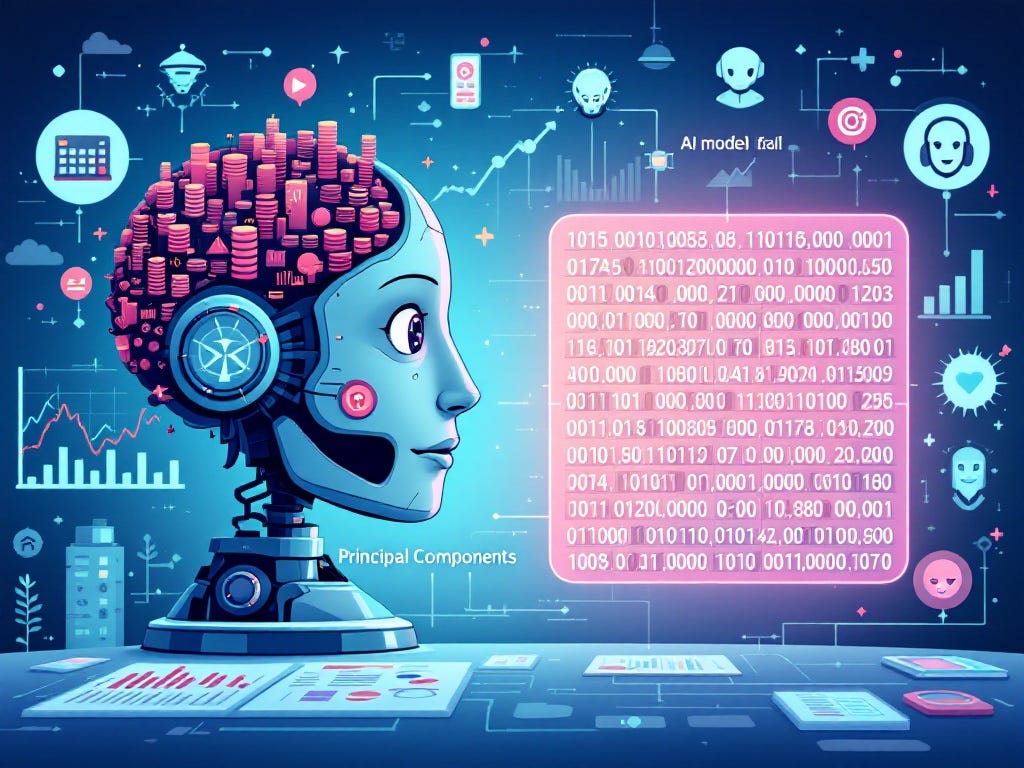
Data overload is a daily reality—whether it's the endless stream of online shopping behavior, the rush of urban traffic, or the constant chatter of smart home devices. When your models get buried under too many features, performance takes a hit.
High-dimensional data can be a headache—whether it’s in your online shopping recommendations or your city’s traffic management system.
When models choke on endless features, there's a secret weapon quietly at work: Principal Component Analysis (PCA). Imagine distilling thousands of data points into a few key insights that drive smarter decisions. That's the magic of PCA, and it’s making a real difference every day.
1. Personalized E-commerce Recommendations
Online shopping is all about understanding what customers really want. Retailers gather tons of information: browsing history, purchase records, product ratings—the list goes on. Yet, not all these details are equally useful. By using PCA, platforms can sift through this noisy data and extract the core signals that truly influence buying behavior.
For instance, rather than analyzing hundreds of overlapping features, PCA condenses them into a handful of “latent factors” like price sensitivity or style preference. This simpler representation allows recommendation engines to group customers with similar tastes more accurately. The result? When you log in to your favorite online store, the products you see aren’t random—they’re tailored to your hidden interests, making your shopping experience smoother and more engaging.
2. Smart City Traffic Optimization
Every city today is a web of sensors tracking everything from vehicle counts to weather patterns. The data generated is immense and can easily overwhelm traditional systems, making real-time traffic management a real challenge. PCA comes to the rescue by transforming the chaos into clarity.
Imagine a city control center where raw sensor data is distilled into a few key trends—like identifying rush-hour peaks, detecting unusual congestion spots, or pinpointing accident hotspots. With these insights, traffic signals can be dynamically adjusted, and rerouting strategies can be implemented on the fly. The outcome is less gridlock, quicker response times during incidents, and an overall more efficient flow of urban traffic that improves daily commutes for thousands of people.
3. Smart Home Energy Management
In today’s connected world, smart homes are brimming with devices that record everything from temperature fluctuations to appliance usage. For homeowners and energy companies alike, making sense of all this data is crucial for saving energy and reducing costs.
By applying PCA to smart home data, complex patterns of energy consumption are simplified into a few dominant trends. These might include identifying the hours when energy use spikes or detecting anomalies that suggest inefficient appliance performance. With these insights, smart systems can automatically adjust heating, cooling, and lighting—optimizing energy usage without any manual intervention. This means lower bills and a greener footprint for the average household.
4. Healthcare Diagnostics and Medical Imaging
Medical imaging technologies like MRIs and CT scans generate enormous amounts of data. For radiologists, spotting subtle signs of disease amidst all that information is both critical and challenging. PCA helps by reducing image complexity, allowing doctors to focus on the most relevant features.
In practice, PCA compresses high-resolution images into a more manageable format that still retains essential diagnostic details. This transformation not only speeds up the analysis but also enhances the visibility of anomalies—making it easier to detect early signs of tumors or other conditions. As a result, healthcare professionals can make faster, more accurate diagnoses, ultimately improving patient outcomes and reducing the strain on medical resources.
5. Financial Risk Analysis and Fraud Detection
Every day, banks and financial institutions process millions of transactions. Hidden among this sea of data are patterns that could indicate fraud or potential financial risks. Traditional methods often struggle to catch these subtleties until it’s too late. Enter PCA, which helps isolate the critical signals from the background noise.
By compressing the high-dimensional transaction data into a few principal components, financial institutions can more easily spot unusual patterns. Whether it's an unexpected overseas purchase or a sudden spike in account activity, PCA-enhanced models can flag these irregularities in real time. This proactive approach to fraud detection not only protects customers but also saves banks from significant financial losses by preventing fraudulent activities before they escalate.
Bringing It All Together
From shaping personalized shopping experiences to keeping our cities moving and our patients healthy, PCA is at the heart of many everyday systems we rely on. It’s a powerful tool that cuts through the complexity of massive datasets, turning them into actionable insights. While many might consider PCA as just another statistical technique, its practical impact is felt across industries—making it a must-have in the modern machine learning toolbox.
Leave a Comment:
Have you noticed these smart systems in action?How do you think simplifying data affects your daily experiences? Share your thoughts and stories below!
Discussion:
Poll:
Subscribe for More ML Insights
If these everyday examples of PCA sparked your curiosity, imagine what a deep dive into hands-on projects could do for you! Subscribe now to receive our full PDF guide on PCA applications, featuring detailed case studies, interactive Python code snippets, and exercises to help you master dimensionality reduction.